
Opinion / Sports, Liability & Ownership
Jalen Hurts Is the Asset. The Eagles Can Replace a Quarterback. He Can’t Replace Himself.
A $255 million contract, a medical decision under scrutiny, and the business of knowing when to walk away.
I’m a Giants fan.
So defending the Eagles’ quarterback isn’t exactly how I planned to spend my Saturday.
But Jalen Hurts’ blood clot situation has nothing to do with the rivalry.
The Eagles have a quarterback problem.
Jalen Hurts has a much bigger decision.
He’s 28 years old. A Super Bowl champion. A Super Bowl MVP. A quarterback whose commercial reach extends beyond the football field.
He signed a $255 million contract with Philadelphia.
But the Eagles didn’t purchase Jalen Hurts.
They purchased the right to his football services under a contract.
That’s a distinction worth remembering now that his health has become the biggest issue surrounding the franchise.
Because the organization has an investment to protect.
Hurts has a life to protect.
And those are not necessarily the same business interests.
The Medical Decision
According to the Eagles’ October 15 statement, Hurts reported that he had been cleated in the calf during the October 4 game against the Rams.
He sought treatment on October 8.
On October 10, while the Eagles were in London, an ultrasound identified a superficial blood clot. The subsequent joint statement from the Eagles and his agent identified the initial diagnosis as superficial vein thrombosis in his left calf.
According to Philadelphia, its medical staff and doctors in London reviewed the findings and determined that he could safely play Jacksonville the following day.
He played.
On October 14, a follow up ultrasound showed movement in the clot, the team said.
On October 19, the Eagles and Hurts’ agent, Nicole Lynn, announced that further evaluations had identified deep vein thrombosis and bilateral pulmonary emboli, or blood clots in both lungs.
Their joint statement described Hurts as clinically stable, said his treatment should involve blood thinners, and said a full recovery was expected.
The statement said he would not be allowed to participate in contact activities, including football, during that treatment.
NFL Network and ESPN reported that he was expected to miss the remainder of the 2026 season. The joint statement did not set a return date.
The positive prognosis is encouraging.
But the sequence of events raises a question that deserves a complete answer.
Was clearing Hurts to play the appropriate medical decision based on what was known at the time?
That’s where I’d begin.
How Liable Are the Eagles?
The NFL has defended Philadelphia’s handling of the situation.
NFL chief medical officer Allen Sills has defended the team’s medical staff, and Commissioner Roger Goodell has said the protocols were followed.
The NFL Players Association has called for a full investigation.
Goodell has said the league welcomes that review.
But the existence of a medical protocol doesn’t automatically resolve every question about professional responsibility.
And the fact that Hurts developed a more serious condition doesn’t automatically establish negligence.
Those are separate issues.
If I represented Hurts, I’d want independent specialists to examine the entire medical record.
What did the first ultrasound establish?
What was the risk of the condition progressing?
What medical guidance was provided about physical contact and international travel?
Was additional testing indicated before the game?
What information did Hurts receive before agreeing to play?
And did any decision or omission contribute to additional harm?
The answers matter.
A potential negligence claim requires more than proving the team knew about a clot.
It requires examining the applicable duty of care, whether that duty was breached, and whether a breach caused legally recognizable harm.
The NFL’s collective bargaining agreement, medical procedures, contractual provisions, and applicable legal remedies would also have to be evaluated. Counsel would need to determine the proper parties, forum, and any applicable workers’ compensation or grievance procedures.
I wouldn’t announce a lawsuit simply because the headlines are alarming.
I’d get the records.
I’d retain the appropriate experts.
And I’d determine what claims, if any, the evidence actually supports.
The Eagles may have acted appropriately.
But if they didn’t, Hurts shouldn’t have to absorb the financial consequences of a preventable medical mistake simply because he’s under contract.
The $255 Million Contract Is Not $255 Million in the Bank
In 2023, Hurts signed a five year extension worth $255 million.
The agreement averages $51 million annually.
According to Over The Cap, the extension included approximately $110 million fully guaranteed at signing.
Over The Cap currently lists his scheduled 2026 cash compensation at $51.5 million and his 2026 salary cap charge at $31,971,800, approximately $31.97 million.
Those are different financial measures.
| Contract measure | Reported amount |
|---|---|
| Total extension value | $255M |
| Average annual extension value | $51M |
| Fully guaranteed at signing | Approximately $110M |
| 2026 scheduled cash compensation | $51.5M |
| 2026 salary cap charge | $31,971,800 |
Source: Over The Cap, checked October 24, 2026. These are reported contract figures, not a statement of Hurts’ current bank balance or retirement entitlement.
The salary cap charge is an accounting figure for the team.
The annual cash figure describes compensation scheduled for that season.
The guarantee at signing describes protections established when the contract was executed.
None of those numbers, by itself, tells us what Hurts could collect if he retired today.
And that’s the number I’d want to understand before making any decision.
The Real Financial Exposure
If I represented Hurts, I would require a complete schedule of his remaining contractual rights.
Not a headline.
An actual financial analysis.
I’d separate money already earned from money still scheduled to be paid.
I’d identify guarantees that have vested, guarantees subject to conditions, and compensation that could be affected by retirement or continued medical unavailability.
Then I’d examine the contract’s treatment of disability, injury, retirement, potential bonus repayment obligations, and any relevant insurance coverage.
Because there are three very different economic outcomes to consider.
| Possible outcome | What I would underwrite |
|---|---|
| Medical recovery and return | Remaining compensation, guarantees, future playing income, and risk |
| Extended medical absence | Contract protections, insurance, benefit eligibility, and financial obligations |
| Retirement or negotiated exit | Earned compensation, remaining enforceable guarantees, possible repayment exposure, and settlement alternatives |
The contract’s full terms and current guarantee status would be necessary to quantify these outcomes.
I wouldn’t invent a settlement number.
And I wouldn’t advise Hurts to surrender contractual leverage before understanding what he owns.
The relevant question isn’t how much the contract was worth when he signed it.
It’s how much protection remains under the circumstances he faces today.
That’s the same discipline I’d apply when evaluating any major business agreement.
The Cost of Continuing
Suppose Hurts makes a full recovery and independent doctors eventually determine he can return to contact football.
Should he?
That’s his decision, informed by his medical team and a proper understanding of the risks.
But I’d make sure he understood the financial alternatives.
He’s already a Super Bowl champion and MVP, with commercial relationships and recognition beyond the field.
I’d compare the additional collectible compensation from continuing with the financial consequences of walking away.
Then I’d evaluate the capital he already controls and the income it can reasonably produce outside football.
I don’t know his personal finances. That’s the analysis I’d require before advising him.
I’m not telling Jalen Hurts to retire. I’m telling him to make sure he can afford to.
That’s financial freedom.
Having enough control over your business to make decisions without being trapped by the need for another paycheck.
The Eagles Can Replace Their Quarterback
Philadelphia has substantial contractual commitments and must find a way to remain competitive without its starting quarterback.
The Eagles can acquire another quarterback, draft one, restructure the roster or change the offense.
The organization will continue operating.
Hurts doesn’t have those same alternatives when it comes to his health.
They can share an interest in his recovery without having identical economic priorities.
That’s why I’d evaluate his future separately from the franchise’s roster problem.
Here’s the Deal I’d Make
If Jalen Hurts were my client, I wouldn’t begin negotiations by discussing his return date.
I’d begin with three objectives.
First, establish the medical facts.
I’d assemble an independent team of physicians and qualified legal counsel.
I’d examine the clearance decision, subsequent diagnosis, and any possible liability.
If the evidence supported a legal claim, I’d pursue the appropriate remedies.
If it didn’t, I’d recognize that conclusion.
The objective would be protecting my client’s interests, not manufacturing a dispute.
Second, protect the contract.
I’d calculate what Hurts is entitled to receive under every plausible outcome.
I’d preserve his existing rights while his medical condition is evaluated.
And if a prolonged absence or permanent departure became necessary, I’d explore a negotiated resolution with Philadelphia that protects as much legitimate contractual value as possible.
I wouldn’t encourage an immediate retirement announcement that might unnecessarily compromise his negotiating position.
Third, build the business beyond football.
I’d review his existing investments, endorsement arrangements, intellectual property, ownership interests, and future commercial opportunities.
I’d prioritize businesses capable of producing recurring revenue without requiring Hurts to perform every day.
I’d establish an operating and investment strategy designed around income, liquidity, capital preservation, and long term ownership.
The goal would be to make professional football optional.
If independent doctors clear him and he wants to return, that’s his decision.
If he decides the risks are no longer worth taking, he should have the financial ability to walk away.
And if the Eagles want to negotiate his future, they should be negotiating with someone who understands the full value of his rights and alternatives.
The Business of Knowing When to Walk Away
Professional sports makes it easy to confuse compensation with control.
A player can earn tens of millions of dollars while depending on his body, his employer, and the continuation of a physically demanding career.
The money is substantial.
But the exposure is real.
And the greatest advantage that money should create is the ability to make choices.
The Eagles have a business to operate.
Jalen Hurts has a life to live.
I’d investigate the medical decision, protect the contract, and build a financial future that doesn’t depend on another football game.
If he returns, it should be because he wants to and independent doctors support the decision.
If he walks away, it should be on his terms.
Financial freedom isn’t just having enough money to keep playing. It’s having enough control to stop.
Jay Moxie | Moxie Talk
Sources and photograph credits
- Philadelphia Eagles statement, October 15, 2026Team account of the October 4 injury, October 8 treatment, October 10 ultrasound, clearance to play and October 14 follow up.
- Eagles and Nicole Lynn joint statement, October 19, 2026Source of the reported diagnosis, clinical stability, treatment plan and prognosis. No medical records were independently reviewed.
- NFL Network reporting, October 19, 2026The season outlook is a reported expectation, not a return date announced in the joint statement.
- 6abc / ESPN, October 21, 2026League defense of the medical process, the NFLPA call for a review, and Goodell’s response.
- Over The Cap: Hurts current contractChecked October 24, 2026. The table uses OTC consistently: $51.5 million scheduled 2026 cash and $31,971,800 cap charge. These are different financial measures.
- Over The Cap: extension announcement, April 17, 2023Five year extension, $51 million annual average, approximately $110 million fully guaranteed at signing. Not a current retirement entitlement.
- NFL and NFLPA collective bargaining agreementArticles 4, 39, 43, 44 and 45 address relevant contract, medical care, grievance and protection issues. The column does not calculate a legal recovery or decide what forum applies.
- U.S. District Court opinion on negligence elementsGeneral Pennsylvania negligence framework only. Does not decide the applicable law, defendants, forum or merits of any Hurts claim.
- NFL: Super Bowl LIX MVP, February 9, 2025Confirms the championship and MVP distinction.
- Andscape: Jordan Brand agreement, August 14, 2023Supports established commercial relationships. No brand valuation, net worth or current endorsement income is asserted.
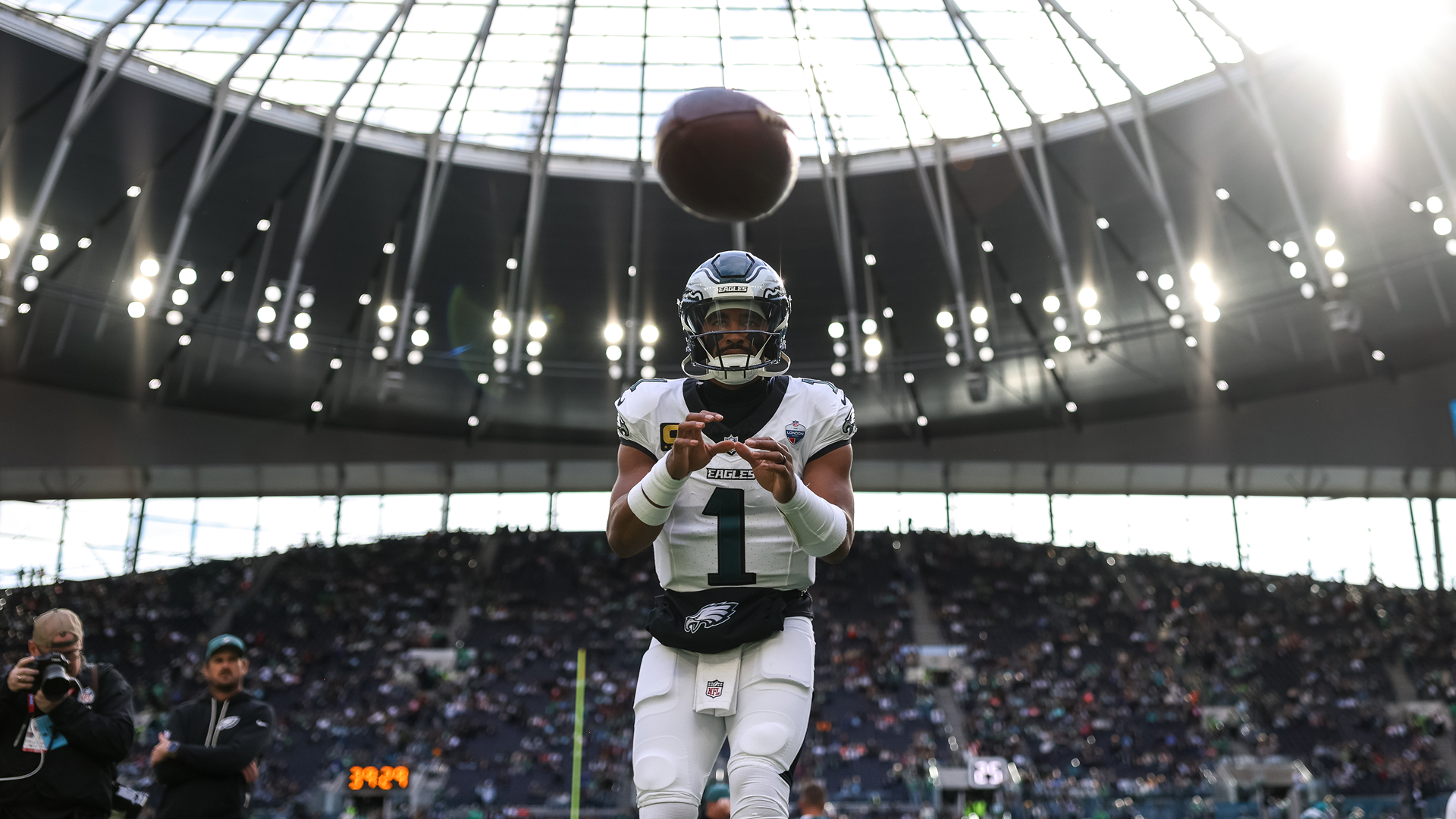
- Photograph: Kiel Leggere / Philadelphia Eagles, October 11, 2026Gallery image 8 of 22 identifies QB Jalen Hurts, date October 11, 2026 and photographer Kiel Leggere. Original public CDN asset is 1920 × 1080.
- Original photo assetOriginal asset without the gallery’s blurred lazy loading placeholder. Image is not generated, enlarged or retouched.
The conversation
When a player is the asset, who should control the decision to return after a health scare?
Loading the conversation…