
Opinion / Sports, Ownership & Capital
Mikal Bridges: The Cost of Running It Back
The Knicks gave up five first round picks to complete a championship roster. They won. Now Bridges is struggling, the second apron is looming, and fans are discovering what it costs to keep a winner together.
Statistics through October 25, 2026. Salary snapshot: October 27, 2026.
Three games.
That's all it took.
The Knicks are 0–3, Mikal Bridges has scored ten points, and suddenly we're talking about whether he's the odd man out.
I understand New York. I understand the impatience.
But before we start trading people, didn't we acquire Bridges to help us win a championship?
We gave Brooklyn five first round picks and a swap to get him.
We won the championship.
Now we're upset because his shot isn't falling during the first week of the next season?
Come on.
I'm not saying Bridges gets a pass. His 2026–27 cap hit is $33.48 million. Three points a game isn't acceptable.
But I want to separate two decisions fans keep treating as one.
Did the Knicks get what they paid for when they acquired him? And is he worth keeping at today's price?
Those are different valuations.
Five First Round Picks. What Were We Buying?
In 2024, New York surrendered four unprotected Knicks first round picks, a protected Milwaukee first rounder, a first round swap and players including Bojan Bogdanovic to acquire Bridges from Brooklyn.
Five firsts and a swap.
That's serious draft capital.
Those picks represented future players, affordable contracts, trade opportunities and flexibility.
The Knicks converted those future possibilities into a player they believed could help them win immediately.
Bridges wasn't supposed to replace Brunson.
He wasn't supposed to lead the league in scoring.
He was supposed to defend the perimeter, space the floor, stay healthy and fit with the rest of the roster.
That was the acquisition thesis.
And in June 2026, the Knicks won the NBA championship.
I'm not crediting Bridges with winning it by himself.
I'm saying the team accomplished the objective behind the investment.
That's a material fact in evaluating what New York bought.
The Production Behind the Championship
Last season, Bridges played every game.
Eighty two games. 2,692 minutes.
He averaged 14.4 points, 3.8 rebounds and 3.7 assists, while shooting 37.1% from three.
His true shooting percentage was 58.7%.
Not superstar numbers.
But he wasn't being asked to carry a superstar's offensive load.
He was part of a team with Jalen Brunson, Karl Anthony Towns, OG Anunoby and Josh Hart.
And when the playoffs arrived, Bridges played all 19 games.
He posted 64.3% true shooting, substantially higher than his regular season mark.
Let's put an actual championship performance on the table.
In Game 5 of the Finals against San Antonio, Bridges played 38 minutes and 34 seconds.
He scored 14 points, made three of seven three pointers, added four assists and a block, and committed no turnovers.
The Knicks won 94–90.
Brunson carried the scoring with 45 points. That's not in dispute.
But the team needed more than one player.
Bridges delivered productive minutes in the game that ended a 53 year title drought.
That's part of what we purchased.
Now we have to determine what those contributions are worth going forward.
Three Games. An Entire Offense in Trouble.
Let's address the current problem.
Through the October 25 game, Bridges is shooting 5 of 23 from the floor and 0 of 10 from three.
He's averaging 3.3 points.
That's terrible production for a player carrying a cap hit above $33 million.
But the Knicks' offense is also struggling as a whole.
Basketball Reference's three game snapshot puts New York last in offensive rating at approximately 102.2 points per 100 possessions, with the defense ranked ninth.
Those are that provider's possession estimates and rankings, not interchangeable with every other site's ratings.
That's important.
It suggests the immediate problem is bigger than one player's jump shot.
Brown coached this team to its championship. Now he has to get this offense working again.
Bridges attempted 11.7 shots and 5.1 threes per game last season.
Through three games, he's attempting about 7.7 shots and 3.3 threes.
His shooting has collapsed, but his opportunities have also declined.
I want to know why.
Is he passing up shots?
Are defenders disrupting his catches?
Is the offense creating fewer clean looks?
Are Brunson and Towns receiving the ball in positions that make it harder to generate opportunities for everyone else?
Are the lineup combinations working?
Those are film questions. The statistics establish the decline, not the cause.
Bridges has to play better.
Brown has to get more production out of his offense.
Both are true.
What Does $33 Million Buy on the Wing?
Here's where I'd stop listening to arguments based on one player's scoring average.
Let's compare Bridges against nine other perimeter players with substantial roles.
Start with OG Anunoby, Derrick White, Jaden McDaniels and Josh Hart.
Then widen the comparison to Desmond Bane, Jaylen Brown, Jalen Williams, Kawhi Leonard and Franz Wagner.
Different responsibilities. Different salaries. Different amounts of basketball delivered.
Bridges averaged about 15.8 points per 36 minutes.
Anunoby produced 18.1.
White produced 17.4.
McDaniels produced 16.8.
Bane produced 21.5.
That tells us something.
Bridges doesn't provide exceptional offensive volume against this group.
Now compare efficiency and shooting volume.
Bridges attempted 5.1 threes a game at 37.1%.
Anunoby attempted 6.1 at 38.6%.
White attempted 8.3, but converted just 32.7%.
McDaniels attempted 3.4 and shot 41.2%.
Those numbers are much more informative than pretending all shooters have identical jobs.
True shooting expands the picture to two point attempts and free throws.
Bridges was at 58.7%.
Anunoby reached approximately 62%.
McDaniels was around 61%.
White was about 53%.
Bridges wasn't the most productive offensive player.
But he also wasn't the least efficient.
And then there's availability.
Bridges played 82 games.
Bane played 82.
White played 77.
McDaniels played 73.
Anunoby played 67.
Jalen Williams played 33.
Franz Wagner played 34.
That matters when you're buying a starter to survive an entire regular season and a championship run.
But simply staying healthy doesn't make Bridges better than those players.
It means New York acquired something management could depend on.
Availability has value. The quality of the available minutes determines how much.
Defense Is More Than Steals and Blocks
The defensive comparison is where fans and box scores can mislead each other.
Bridges averaged 1.3 steals and 0.8 blocks last season.
Those are real contributions.
But steals and blocks don't tell us who guarded the most difficult assignments or how a possession was defended.
Evaluating that work requires possessions, matchups and lineup context.
An on court or on/off number isn't an individual defensive grade. Teammates, opponents and lineup combinations influence the result.
I wouldn't treat defensive reputations as interchangeable.
Anunoby made the All Defensive Second Team last season. Derrick White made the All Defensive First Team.
Bridges isn't automatically the best defender in this group.
And he doesn't need to be for the Knicks to benefit from him.
The question is which assignments he handles, what other players can concentrate on because he's there, and what happens when his minutes must be replaced.
Trading Bridges Changes Everyone Else's Job
Brunson directs the offense.
Towns commands attention as a scorer and shooter.
Anunoby handles significant defensive responsibilities.
Hart rebounds, facilitates and connects possessions.
Bridges is supposed to fill the space between them.
If you remove him, that work doesn't disappear.
Maybe Anunoby takes more perimeter assignments.
Then who covers the assignments Anunoby previously handled?
Maybe Hart plays more minutes at a different position.
Then what changes in the team's rebounding, spacing and offensive rhythm?
Maybe a new player scores more.
Does he defend enough to stay on the court in the playoffs?
That's the hidden cost of replacing Bridges.
Not just the difference between two salaries.
The change in the whole operation.
Championship teams require people who understand their jobs together.
You can't reduce that to five individual scoring averages.
The Second Apron Is Where the Business Gets Difficult
The NBA's 2026–27 salary cap is $164.961 million.
The luxury tax threshold is $200.428 million.
The first apron is $209.015 million.
The second apron is $221.686 million.
SalarySwish's October 27 snapshot lists the Knicks' cap hit at $220,861,653 and second apron room at $824,347.
That is a dated public snapshot. The league's apron calculation also includes applicable bonuses and other adjustments, so a completed transaction requires its own calculation.
Now look at the largest cap hits.
Towns carries approximately $57.08 million.
Anunoby carries $42.5 million.
Brunson carries $37.74 million.
Bridges carries $33.48 million.
Hart carries $20.92 million.
Using their unrounded figures, that's approximately $191.72 million for five players.
And the team still has to employ everyone else.
This isn't simply about whether James Dolan can afford another luxury tax payment.
The NBA restricts roster transactions according to payroll levels.
Above the first apron, teams face tighter trade matching and acquisition rules.
Crossing the second adds restrictions involving aggregating outgoing salaries in trades, certain trade assets and other roster building tools.
That's why management has to calculate more than the price of the players.
It has to calculate the flexibility those contracts preserve or eliminate.
And because New York is already above the ordinary salary cap, reducing payroll by several million dollars doesn't automatically give it that same amount to spend on free agents.
You can create room beneath an apron without creating ordinary salary cap room.
That's a distinction every Knicks fan discussing a Bridges trade should understand.
Let's Make Up Three Trades
I'm not reporting trade negotiations. These are hypothetical strategies.
Trade one: Replace Bridges with a cheaper defensive starter.
Suppose the Knicks exchange his $33,482,145 cap hit for $26 million in incoming salary, with no other adjustments.
Under the same payroll assumptions, New York saves $7,482,145.
The resulting payroll would be $213,379,508, leaving $8,306,492 below the second apron.
But the team remains above the salary cap and first apron.
And the replacement must still defend, shoot and handle starter minutes.
A transaction that improves payroll but weakens the playoff rotation isn't automatically a good trade.
Trade two: Replace Bridges with a stronger scorer.
Maybe the offense gains secondary shot creation.
Maybe Brunson receives more help.
But what happens to the defense?
Does the replacement cost more?
What responsibilities move to Anunoby and Hart?
And can the transaction legally be completed within the applicable trade rules?
A more exciting name can be a worse investment.
Trade three: Exchange Bridges for draft assets and flexibility.
You might replenish future trade capital.
You might reduce future salary commitments.
But the team is defending a championship right now.
A draft pick several years away doesn't automatically improve the next playoff run.
And those are not necessarily the same picks surrendered to Brooklyn.
There's a fourth option.
Keep Bridges.
Fix the offense.
Evaluate the other contracts.
And preserve the combination that delivered a championship until the evidence supports a better transaction.
Two Different Investment Decisions
Here's where I want fans to separate the economics.
In 2024, the Knicks paid five first round picks and a swap to acquire Bridges.
That is historical acquisition cost.
It matters when judging whether management made the right decision.
But those picks are already gone.
Keeping Bridges solely because of the original price would be allowing a sunk cost to dictate the future.
Trading him for inadequate value because of three bad games would be another version of the same mistake.
Now his value depends on a different set of questions.
What will he produce over the remaining contract?
What can New York acquire in exchange?
What happens to the rest of the lineup?
How much payroll and apron flexibility changes?
What does the replacement cost?
And does the move improve the probability of another title?
That's how I'd evaluate the asset today.
Not by reliving the trade announcement.
The Cost of Running It Back
We wanted the Knicks to go all in.
They did.
We wanted a championship.
They won.
Now three games into the next season, we're trying to decide which player has to go?
I understand being frustrated with Bridges.
He has to shoot better. He has to produce.
And management has to be willing to examine his contract like every other investment.
But the Knicks already paid the acquisition cost.
Now they have to decide what the asset is worth today.
Maybe Bridges eventually becomes the contract they move.
Maybe he doesn't.
Either way, I want the decision based on what it takes to win again.
Not what gets the biggest reaction after an ugly week.
Don't confuse a bad opening week with a bad acquisition. And don't confuse yesterday's purchase price with tomorrow's value.
Jay Moxie | Moxie Talk
Sources and photograph credits
- NBA trade record
Final trade package, July 2024.
- NBA official Finals Game 5 scorer report
June 13, 2026. Bridges 38:34, 14 points, three of seven threes, four assists, one block, no turnovers. Knicks 94, Spurs 90. Brunson 45.
- Mike Brown appointment
Hired July 7, 2025. He coached the championship season.
- 2026 All Defensive teams
White First Team. Anunoby Second Team.
- Knicks team rating snapshot
Three games through October 25. Provider possession estimates may differ from NBA ratings.
- NBA 2026–27 thresholds
League cap, tax and apron levels effective July 1, 2026.
- Knicks salary snapshot
Read October 27, 2026. Cap hit $220,861,653 and listed second apron room $824,347. Five leading cap hits total $191,724,154.
- NBA CBA 101
Apron transaction restrictions, apron salary adjustments and trade matching. Hypothetical payroll arithmetic is not an executable trade.
- Opening three games
October 26 reporting on the 0–3 start and Bridges shooting. No claim about the later October 27 game.
- Mikal Bridges / 2025–26
Historical regular season statistical table. Roles and shot volume differ.
- OG Anunoby / 2025–26
Historical regular season statistical table. Roles and shot volume differ.
- OG Anunoby / 2025–26
Historical regular season statistical table. Roles and shot volume differ.
- Derrick White / 2025–26
Historical regular season statistical table. Roles and shot volume differ.
- Jaden McDaniels / 2025–26
Historical regular season statistical table. Roles and shot volume differ.
- Josh Hart / 2025–26
Historical regular season statistical table. Roles and shot volume differ.
- Desmond Bane / 2025–26
Historical regular season statistical table. Roles and shot volume differ.
- Jaylen Brown / 2025–26
Historical regular season statistical table. Roles and shot volume differ.
- Jalen Williams / 2025–26
Historical regular season statistical table. Roles and shot volume differ.
- Kawhi Leonard / 2025–26
Historical regular season statistical table. Roles and shot volume differ.
- Franz Wagner / 2025–26
Historical regular season statistical table. Roles and shot volume differ.
- Bridges playoff statistics
2025–26 playoffs: 19 games, 64.3% true shooting.
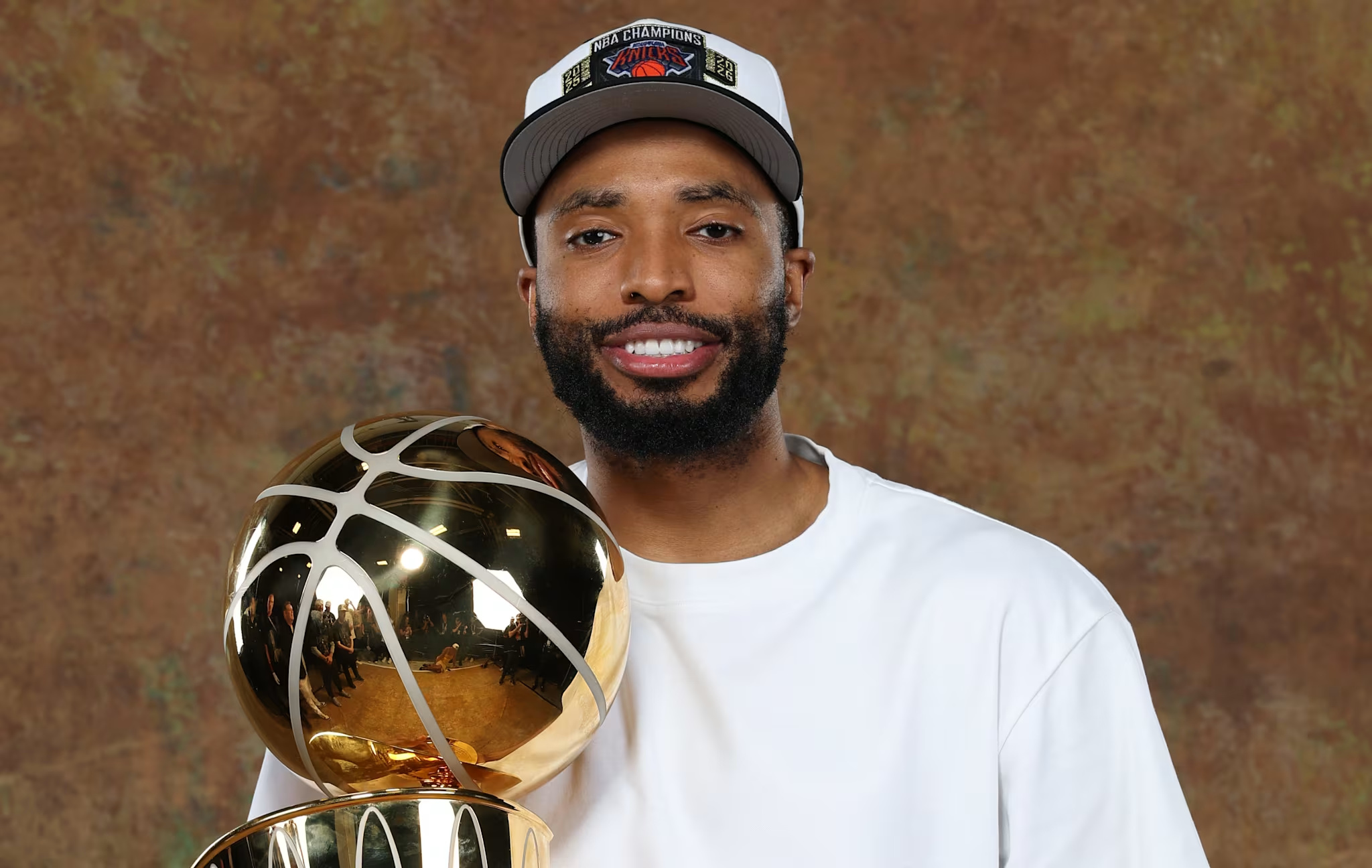
Hero photograph: Mikal Bridges with the Larry O’Brien Trophy. Nathaniel S. Butler / NBAE via Getty Images, as credited by Complex, June 17, 2026. Original supplied image rendition 2048 by 1296 pixels, no enlargement. Copyright remains with the credited rights holder.
The conversation
What would you give up to keep this Knicks roster together?
Loading the conversation…