
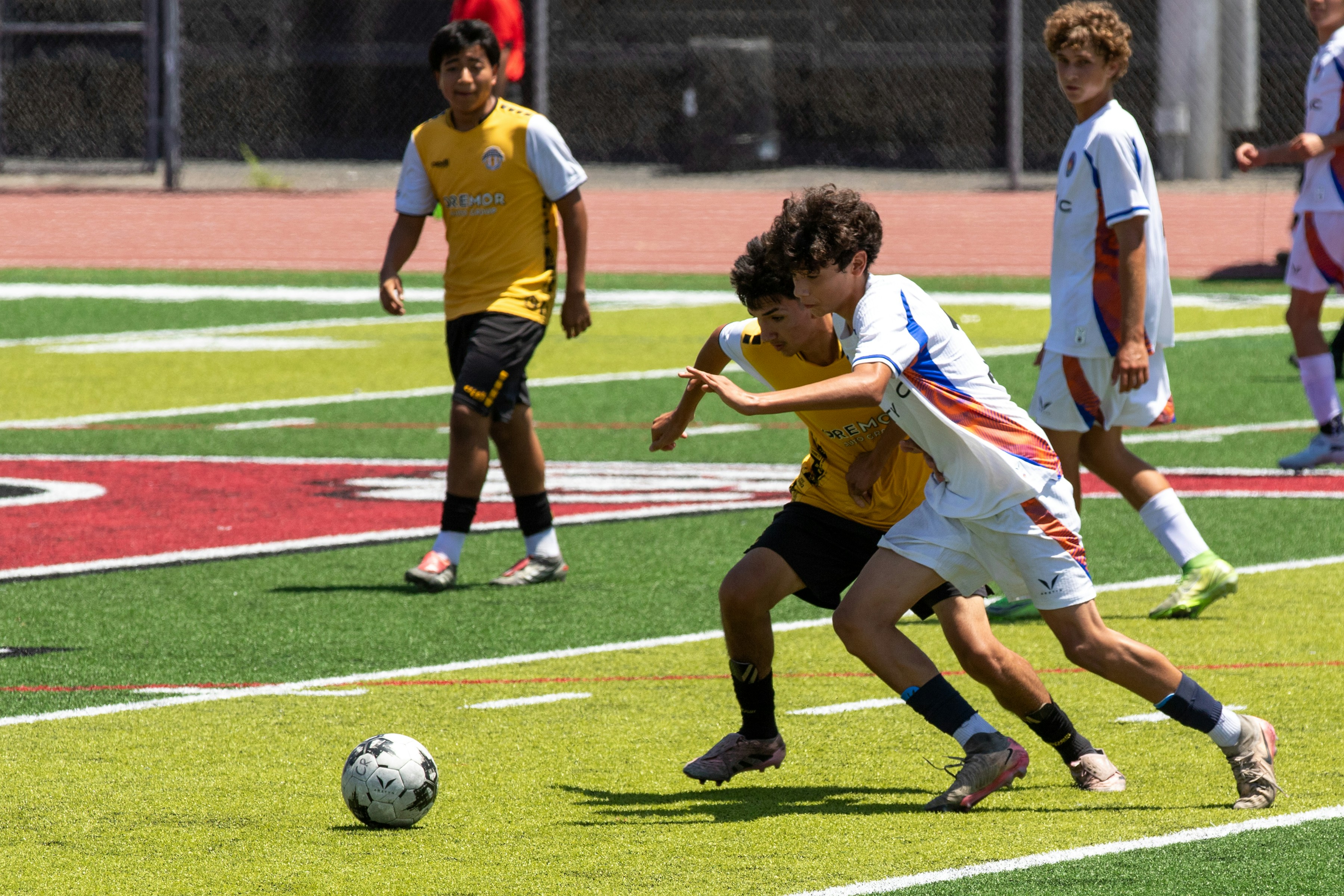
Opinion / Sports, Parenting & Business
We Stopped Keeping Score. The Youth Sports Business Didn't.
A three year old soccer player, a call to the police, and a youth sports industry collecting billions from parents. When did losing become something adults couldn't handle?
A three year old boy is playing soccer.
He's running around the field, controlling the ball, scoring goals, and enjoying himself.
The adults start arguing.
Somebody calls the police.
What the hell are we doing?
His name is Nevada Pierre. He's three years old, playing organized soccer in Winter Park, Florida, against children older than him.
The kid can play.
His parents say he was being singled out because he was outperforming the competition.
The league official tells a different story. He says Nevada was pushing other children, and his parents became disruptive over playing time.
We have the 911 call, police footage, and statements from both sides.
What we know is that a league official called police on October 24, 2026, over a dispute involving the adults.
Police determined the matter was civil, not criminal. Nobody was arrested, formally trespassed, or forced from the park by police.
That's the documented situation. Source: ClickOrlando
Now I want to discuss something bigger.
Why are we so quick to involve law enforcement when adults disagree?
Why does somebody else's child being better at something create so much frustration?
And what are these youth sports businesses actually selling to the parents who keep paying them?
Because I've been around youth sports long enough to recognize a bigger problem.
We've confused equality with entitlement, participation with achievement, and paying for an opportunity with purchasing a result.
And the business keeps collecting the money.
We Stopped Keeping Score
My little brother is 32 years old now.
He's a father, and my nephew plays sports.
When my brother was a kid, I signed him up for basketball.
One of the first programs we went to didn't keep score.
I had never heard of such a thing.
A basketball league where nobody wins and nobody loses?
We left.
I wanted him to learn the game.
And learning the game included understanding the score.
Fast forward.
My children played Pop Warner football.
At the end of the season, everybody got a trophy.
Didn't matter whether your team won a game.
Didn't matter whether you improved.
Didn't matter whether you accomplished anything beyond showing up.
Everybody got recognized.
Now I understand acknowledging commitment and participation.
But recognition for participation and recognition for achievement aren't the same thing.
And somewhere along the way, we've confused them.
I'm not suggesting participation trophies created an entire generation of people who can't compete. That would be too simple, and it would go beyond what my experience proves.
Parents had unrealistic expectations long before anybody started handing out participation trophies.
What I'm questioning is the message we send when we remove every visible distinction between participating and achieving.
Because the real world keeps score.
Sometimes you win.
Sometimes you lose.
Sometimes somebody is much better than you.
And sometimes you lose to somebody who isn't even as good as you.
That's life.
The Delusion of Fairness
Somewhere along the way, we started confusing equality with everybody getting the same result.
That's not equality.
Equality is access.
Access to the court.
Access to coaching.
Access to practice.
Access to competition.
Access to an opportunity to improve.
It doesn't mean everybody deserves the same playing time at every level.
It doesn't mean everybody has the same ability.
And it certainly doesn't mean everybody gets to win.
The world isn't fair.
Sometimes you're going to lose to somebody who isn't as good as you.
Sometimes a referee is going to make a terrible call.
Sometimes somebody is going to cheat.
We've seen documented gambling and officiating scandals in professional sports. Former NBA referee Tim Donaghy pleaded guilty in 2007 to participating in an illegal sports betting scheme involving NBA games. These aren't imaginary possibilities.
But none of that means we should abandon competition.
It means we should teach children how to recognize unfairness, challenge it appropriately, and keep competing.
That's a much more valuable lesson than pretending unfairness doesn't exist.
Now look at the parents.
Everybody wants their child to be LeBron James.
Or Anthony Edwards.
They see the contracts.
The endorsements.
The highlights.
The lifestyle.
But how many of them are studying the work?
The years of training.
The conditioning.
The repetition.
The competition those athletes survived just to reach that level.
They want the outcome without understanding the process.
And when their own child doesn't perform the way they imagined, somebody else becomes the problem.
The coach.
The referee.
The other child.
The league.
Anybody but the expectations they created.
Are we raising children to become competitors, or are we teaching them how to become professional excuse makers?
Because losing doesn't make you a loser.
Failing doesn't make you a loser.
Being less talented than somebody else doesn't make you a loser.
But refusing to learn, refusing to improve, and expecting everybody else to accommodate your shortcomings can become a way of life.
And that behavior doesn't start with the children.
It starts with the adults.
A parent who can't accept losing has a difficult time teaching a child how to lose.
A parent who believes every setback is somebody else's fault has a difficult time teaching accountability.
And a parent who confuses equality with guaranteed outcomes can spend an entire childhood preparing their child for a world that doesn't exist.
Real equality is access to opportunity, not protection from competition.
The child who loses should have access to coaching and the chance to improve.
The child who wins should have access to greater challenges.
Neither child benefits when adults pretend the difference between them doesn't exist.
You don't create equality by lowering the standard. You create opportunity by giving people access to the tools required to meet it.
I've Coached Youth Basketball. I've Seen the Parents.
I've coached youth basketball.
So when I talk about the behavior of parents at children's sporting events, I'm speaking from experience.
And I can tell you the kids weren't always the hardest part.
The parents were.
Some parents understood exactly why their children were there.
They wanted them active, physically fit, learning discipline, competing, and enjoying themselves.
They wanted their children to do their best.
Those parents were great.
Then you had parents who treated basketball like babysitting.
Their child didn't want to play.
Didn't want to practice.
Didn't want to be there.
But the parent wanted somewhere to drop them off.
Then you had the parents who wanted me to be the enforcer.
They couldn't get their child to listen at home, so basketball became punishment.
Now I'm supposed to discipline a child through a sport the child doesn't even like.
And then there were the parents convinced they were raising the next Kobe Bryant or Shaquille O'Neal.
Every missed shot was somebody else's fault.
Every substitution was disrespect.
Every other child receiving more attention was taking something away from theirs.
Some had already decided their child was going to be the family's meal ticket.
The expectations were professional.
The ability wasn't.
Now there were some exceptional children.
That small percentage whose ability stood out immediately.
You didn't need a parent telling you how good they were.
You could see it.
But most children weren't that kid.
And there's nothing wrong with that.
Your child might not be great at basketball.
They might not even like basketball.
Maybe their strengths are somewhere else.
We need scientists.
Engineers.
Teachers.
Mechanics.
Sanitation workers.
Entrepreneurs.
We need people doing all kinds of useful work.
Not every child needs to become a professional athlete.
And not every childhood activity needs to become a career.
That's where parents need to stop confusing their dreams with their children's abilities.
The Parents Pay. The Leagues Collect.
Now let's talk about the business.
According to the Aspen Institute's Project Play research, the average American sports family spent $1,016 on a child's primary sport in 2024.
That's up 46% from 2019.
The same families estimated another $475 for that child's other sports.
That's $1,491 annually.
For one child.
The Aspen Institute estimates American parents collectively spend more than $40 billion annually on youth sports activities.
That's spending throughout the youth sports economy, not the profit of the leagues alone.
But think about how much money is moving through this market.
The parents are the customers.
The children are supposed to receive the benefits.
But parents aren't all purchasing the same thing.
Some want exercise.
Some want recreation.
Some want discipline.
Some want a babysitter.
Some want social development.
And others believe they're investing in the next professional athlete.
The industry collects from all of them.
That's where the incentives get interesting.
Because a business can make money providing honest athletic development.
It can also make money selling expectations a child may never fulfill.
More camps.
More tournaments.
More private instruction.
More travel.
More registrations.
More exposure.
Those services can provide real value.
But paying for more services doesn't automatically mean a child is developing professional potential.
And a business doesn't necessarily have a financial incentive to tell a parent their child doesn't need to purchase another program.
Are parents buying development, or are they buying hope?
Hope is an attractive product when the imagined payoff is an NBA contract, an NFL career, a scholarship, or an NIL deal.
First It Was the League. Then a Free Education. Now NIL.
When I was growing up, parents who thought their child was good at basketball had one dream.
He's going to the league.
When that started sounding unrealistic, the conversation changed.
Well, at least he'll get a free education.
Now we have NIL, which allows athletes to receive compensation for their name, image, and likeness. Newer arrangements also allow some direct payments from colleges.
And the pitch has changed again.
A child might make six figures before finishing high school.
A couple million dollars in college.
And suddenly some parents are treating a young athlete like an investment that's supposed to generate income for the family.
The money is real. Some athletes have substantial endorsement opportunities.
But that doesn't mean the average child playing organized sports is on a path toward a six figure deal.
Let's examine the actual populations.
Division I Is One Outcome
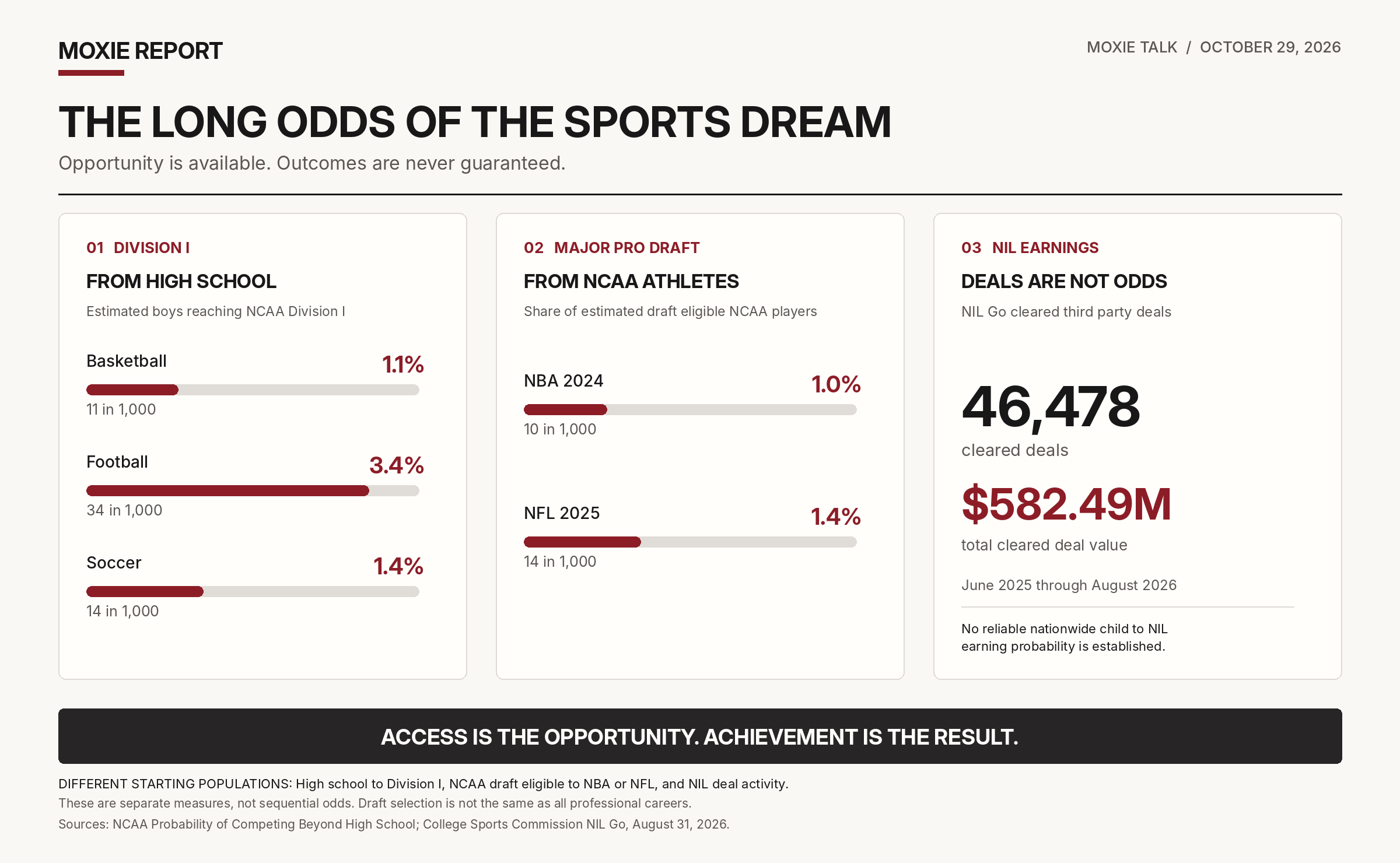
According to the NCAA's latest published participation estimates, approximately 1.1% of high school boys basketball participants advance to NCAA Division I, compared with 3.4% in football and 1.4% in boys soccer.
Out of 1,000 high school participants, that corresponds to about 11 basketball players, 34 football players, and 14 soccer players reaching Division I.
These are approximate national rates, not predictions for a particular child.
Who actually reaches the next level?
Choose a sport. Each panel has its own starting population. These national estimates do not predict an individual child’s future.
Into NCAA Division I
About 11 of every 1,000 high school boys basketball participants
Starting population: high school boys participating in this sport.
Into major professional draft
NBA 2024: about 10 of every 1,000 draft eligible NCAA players
Starting population: estimated draft eligible NCAA players across divisions. This is a different group from the high school panel.
Cleared third party deals
Deals, not unique athletes
Total cleared value from the platform launch through August 31, 2026. This is commercial activity, not an earnings probability.
These are different starting populations. Do not multiply the percentages into one probability. Sources: NCAA participation estimates and methodology and College Sports Commission report.
View the full data graphic
Professional Drafts Are Another Outcome
The NCAA estimates that 1.0% of its draft eligible men's basketball cohort was selected in the 2024 NBA draft.
For football, approximately 1.4% of estimated NCAA draft eligible athletes were selected in the 2025 NFL draft.
Those are not percentages of all children who begin playing sports, nor even of all high school players. They use estimated NCAA draft eligible populations across divisions.
Draft selection is also not the same thing as every possible professional career. Basketball players may compete overseas or in other leagues without being drafted by the NBA.
NIL Is Not a Probability
The College Sports Commission reported 46,478 cleared third party NIL deals with a combined value of $582.49 million from the platform's June 2025 launch through August 31, 2026.
That's real commercial activity.
But 46,478 deals doesn't mean 46,478 athletes.
The $582.49 million total doesn't establish average earnings per athlete.
And those figures don't establish the chance of a middle school child earning $100,000, much less a million dollars.
These are different starting populations. They cannot be multiplied together into one fictional probability of a child becoming rich through sports.
So when somebody sells a parent the dream of millions through youth sports, I want the numbers.
How many children entered the program?
How many actually reached Division I?
How many earned scholarships?
How many received meaningful NIL compensation?
How many made a professional roster?
And what did their families spend getting there?
That's how you evaluate an investment.
Not by pointing at a superstar and pretending every child is on the same path.
You can dominate recreational basketball and struggle in travel sports.
You can dominate travel sports and never start for your high school.
You can be exceptional in high school and still not receive a Division I opportunity.
You can reach Division I without earning significant NIL money or becoming a professional athlete.
Different levels.
Different populations.
Different economics.
Different probabilities.
You can pay for development. You can't buy professional potential.
i9 Sports Is a Business
Now look at the company involved in Nevada's game.
i9 Sports operates a youth sports franchise system.
It advertises inclusion, convenience, sportsmanship, and equal playing time, with no tryouts or drafts. It also says it keeps score and teaches children to win and lose appropriately. Source: i9 Sports
That's the product.
And there's nothing inherently wrong with it.
Recreational sports can provide important access for children who aren't ready for or interested in intense competition.
But the league is responsible for delivering the recreational experience it advertises.
Its 2026 franchise disclosure figures, reproduced by independent researchers, show 129 reporting franchises with $514,066 average annual revenue and $406,242 median annual revenue for the period ending September 30, 2025.
Revenue isn't profit, and those aren't the financial statements of the particular program Nevada attended.
The disclosure lists a royalty of 7.5% of network revenue, a 2% national brand fund contribution, and a minimum local advertising obligation of 2%, subject to minimum amounts and contractual terms.
What a franchise earns is not what it keeps
Illustration only. This is not an actual franchise profit statement or a forecast. Royalty and brand fund minimums may increase amounts owed. Local advertising is spending by the franchise, rather than an additional royalty collected by the franchisor. Excludes fields, staffing, coaching, insurance and other costs. The revenue sample covers October 1, 2024 through September 30, 2025. 2026 franchise disclosure transcription.
The operating franchise collects registrations, pays expenses, and owes fees to the brand.
That's not just someone organizing a pickup game at the park.
It's a commercial relationship with customers, contractual obligations, operating costs, and real financial incentives.
And I want to know what happens when the expectations of the paying parent conflict with the child's development.
If one child is significantly better than the others, what does the program do?
Teach the other children how to defend?
Help the talented child develop passing, teamwork, and positioning?
Find a more challenging environment?
Or let the adults turn the game into a dispute?
If Nevada was pushing children, enforce safety rules.
If his parents were disruptive, address their conduct.
If the company promises equal playing time, honor its policy.
But don't confuse ability with misconduct.
And don't confuse customer satisfaction with athletic development.
Is the organization developing the children, or managing the expectations of the adults paying the fees?
The two can work together. They aren't automatically the same thing.
I Want My Children to Get Their Asses Kicked
I want my children to compete.
I want them to get their asses kicked sometimes.
In a controlled environment.
With coaches, supervision, rules, and an opportunity to learn.
I want them to discover that somebody else can be faster.
Stronger.
Better coordinated.
Better prepared.
More disciplined.
And sometimes just better.
What happens next matters more to me than the score.
Do you practice?
Do you work on your conditioning?
Do you listen to the coach?
Do you understand what the other player did?
Do you come back better?
Or do you make excuses?
I want my children physically fit.
I want them disciplined.
I want them to respect their bodies.
Respect their teammates.
Respect their opponents.
And understand that losing isn't the end of the world.
Sometimes you're going to get a bad call.
Sometimes you'll lose to somebody you should've beaten.
Sometimes you'll do everything right and still fail.
That's life.
But you don't call the police because somebody kicked your ass on the court.
You learn how to get better.
And I never understood the idea that losing was supposed to feel good.
Playing can be fun.
Competing can be fun.
Improving can be rewarding.
Losing can hurt.
And that disappointment can teach you something.
The objective shouldn't be making sure children never experience defeat.
The objective should be helping them develop the skills to respond to it.
When Did Every Disagreement Become a Police Matter?
A league official called 911 at a children's soccer game.
A dispute over the adults' conduct and a child's playing time ended with police on the field.
And that raises a question that extends well beyond youth sports.
When did adults start treating competition disputes as matters for law enforcement and government intervention?
In July 2026, the same impulse to escalate a sports controversy appeared at the highest levels of government.
Eleven Republican members of the U.S. House of Representatives, led by Representative August Pfluger, sent a letter to WNBA Commissioner Cathy Engelbert about physical play against Caitlin Clark. They questioned the league's handling of repeated contact, requested answers about player safety, and raised the possibility of federal investigations if discrimination or retaliation were taking place.
The WNBA responded to the lawmakers later that month. This was congressional pressure and correspondence, not proof that Congress held a hearing or that a federal criminal investigation had begun. Sources: Associated Press, House Republican Study Committee
Think about where the argument had traveled.
From a basketball court.
To league officials.
To elected members of Congress.
To the possibility of federal agencies becoming involved.
And understand, player safety is real. On June 24, Phoenix Mercury player Alyssa Thomas made contact with Clark's throat during a game. The WNBA later upgraded the play to a flagrant foul and suspended Thomas for one game. Thomas described it as an accident. Clark and her coach condemned threats directed at Thomas.
That is exactly the kind of play a league has a responsibility to review and discipline appropriately.
But there's an important difference between arguing that a foul was dangerous and alleging that a professional basketball league has committed a federal offense.
A missed call is not automatically discrimination.
A flagrant foul is not automatically a crime.
A hard game is not automatically a hostile workplace.
And genuine criminal violence is not something we should dismiss as basketball.
The facts matter. The available procedures matter. Proportion matters.
We have referees.
League rules.
Video review.
Technical fouls.
Flagrant fouls.
Ejections.
Suspensions.
Appeals.
Those institutions are there to manage competition and correct misconduct within it.
If they fail, challenge them with evidence and through the proper channels. If there is actual criminal conduct, respond accordingly.
But why are we so quick to turn every heated sports disagreement into a demand for somebody with government authority to step in?
It's the same question I ask about that Saturday in Winter Park.
The child's family and the league official give conflicting accounts. The police determined the matter was civil and made no arrests.
The disagreement needed responsible adult management. Whether a safety rule was broken, whether a playing time promise was honored, and whether parents were disruptive were questions the league should have been equipped to address.
Children shouldn't be learning from adults that the first answer to a disputed result is to summon a bigger authority to make the conflict disappear.
They should be learning how to follow rules, challenge genuine unfairness, and continue competing.
It's Okay to Be Great
Another child's excellence isn't an insult to yours.
If somebody is better, that's an opportunity to learn.
If your child loses, let them feel disappointed.
Then help them figure out how to improve.
Don't manufacture excuses.
Don't demand the competition be weakened.
And don't convince your child that the world owes them a better result.
At the same time, if your child is the one dominating, let them develop.
Teach them teamwork.
Teach them to pass.
Teach them to respect the other children.
Find appropriate competition.
But don't make them feel that being good at something is wrong.
Nevada is three.
He looks talented.
His family says he practices and loves soccer.
That's enough.
We don't need to project an entire professional career onto a three year old.
Let him enjoy being a child.
Let him play.
Let him practice.
Let him improve.
The Business Should Deliver More Than a Trophy
I don't have a problem with recreational sports.
I don't have a problem with children participating for fun.
I don't even have a problem with giving a child something to recognize their commitment.
I have a problem when participation is sold as achievement.
When parents confuse paying with developing talent.
When leagues confuse customer satisfaction with athletic development.
And when adults are so uncomfortable with losing that they teach children to look for somebody to blame rather than something to improve.
The parents should be purchasing a safe place to learn.
Coaching.
Rules.
Teamwork.
Discipline.
Competition.
The opportunity to try again.
I don't need a coach telling me my child is going to the NBA.
I need a coach who can tell me what my child does well, what needs improvement, and whether the child even wants to keep playing.
I don't need a league promising nobody will ever feel bad about losing.
I need a league that teaches children how to handle the score.
Because the world is going to keep score whether the youth league does or not.
And I don't want my children reaching adulthood believing the answer to somebody else's success is removing them from the competition.
Are we teaching children how to compete in the real world, or are we paying businesses to protect them from discovering where they stand?
The businesses can sell access.
They can sell coaching.
They can sell facilities, instruction, competition, and development.
They can't guarantee the outcome.
And parents need to understand the difference.
It's okay to be great. It's okay to lose. It's okay to fail a few times. It's okay to discover you're not the best.
What isn't okay is teaching children that somebody else's excellence is an injustice that must be corrected.
You don't create equality by lowering the standard. You create opportunity by giving people access to the tools required to meet it.
Sometimes failure is where the learning begins.
I don't pay for my children to avoid losing. I pay for them to learn what to do after they lose.
Jay Moxie | Moxie Talk
Access Is Freedom
The ability to learn, practice, develop skills, and use technology starts with access to practical tools and information. Explore Howtify.
Sources and photograph credits
- ClickOrlando, October 26, 2026. Police statement and the adult dispute in Winter Park.
- WESH 2, October 27, 2026. Statements from Nevada's father and the league official.
- Aspen Institute Project Play. Survey of family sports expenditures.
- NCAA, Probability of Competing Beyond High School. College participation estimates and draft cohort methodology.
- College Sports Commission, NIL Data Report through August 31, 2026. Cleared third party NIL activity.
- i9 Sports, About and i9 Sports, Experience. Recreational program policies.
- Franchise FDD Figures, i9 Sports. Transcription of 2026 disclosure figures, including different revenue cohorts.
- Associated Press, July 9, 2026. Reporting on congressional letter and WNBA discipline.
- House Republican Study Committee, July 8, 2026. Lawmakers' announcement of letter to WNBA commissioner.
- Coverage of WNBA's July 24 response. Follow up on congressional correspondence.
- U.S. Department of Justice, August 15, 2007. Tim Donaghy guilty plea involving NBA betting.
The conversation
Who benefits when parents treat a youth sports loss like a crisis?
Loading the conversation…